From Writing to Publishing

Homework for Bloggers

image

Here’s a confession:  I had no idea what to do with a blog. Yes, I have one and I do post frequently, but I didn’t really know what I was doing (or why) in conjunction with my writing career. As usual, Jeff Goins gave me direction.

What are the 5 platforms for building an audience? He describes them, then tells you to pick one.
The Journalist
The Prophet
The Professor
The Artist
The Star
(Sign up for his newsletter if you would like to learn more at Goins Writer.)

After listening to his explanation of each, I found myself gravitating to the one I would have never expected – The Professor.

The whole time Jeff was describing it, I was thinking “Nope. Not me. I’m not a teacher.” But then I looked at my blog. “A writer writes about writing.”  Isn’t that exactly what I have been doing this whole time? Teaching?

The Professor

At the end of each video, Jeff gives us homework. My homework is to pick one of those categories and build a platform.

Well, ladies and gents, I have some more tutorials coming for you. As I build my platform – Le Professeur – I will continue researching in the direction of querying a writing agent. For all those interested, stay tuned. We’ll get through this together.

This has been,

Fanny T. Crispin

From Writing to Publishing

Writing “Muse”

image

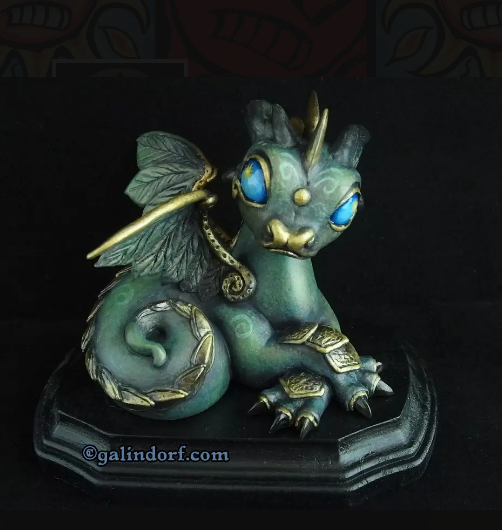
Rizzle-Razzle is so stinkin’ cute! (Can’t decide between the names Rizzle and Razzle, so there you go).

I commissioned this little baby from the wildly talented Galindorf last year and just received word that he is complete. I am now the proud foster mommy of an earth dragon. Go get yours. Galindorf does custom work!

I suppose you’re wondering where I’m going with this post. Me, too. I don’t normally do plugs on my blog, but this is a special occasion.

What do we know of the elusive Muse?

Within the writing circle, we artistics can get creative and playful with our craft. You may hear authors say, laughingly, that their characters “talk” to them, or maybe a story will “run away from them”. If we’re going to give so much imaginative freedom to writing, we might as well embody inspiration as well.

A Muse can be a physical or ethereal being which comes and goes at random. This explains why inspiration will strike wildly out of nowhere, but leave us empty for long periods of time. Depending on your levels of inspiration, your Muse might be described as “flighty”, “mischievous”, or “energetic”.

Prompt
Think about your own inspiration. See if you can imagine a creature that might visit you to bestow such gracious creativity to your writing. Then in the comments below, describe your Muse, name it, and introduce it to the world. Oh, and let’s have some fun.

Fanny T. Crispin

From Writing to Publishing

Study, Study, Study

Writers are desperate people. When they stop being desperate, they stop being writers.

In this day and age, one can have a college major in Creative Writing. What a novel concept! To think, you can go to college studying and learning more about what you love doing. I’ll be the first to admit that I originally scoffed at the notion. Nobody consciously wants to join the “starving artist elite”, so why spend so much time and valuable money in a boring classroom?

I’m what you call a self-learner. I become intrigued with something and dig up a bunch of resources to learn about it. I taught myself the majority of my art skills, the Continental knitting technique, and much of what I know about writing and self-publishing. My teachers have been books and the good, new Interweb. When I heard about people going to college for Creative Writing, I thought, What’s creative about college?

Let’s talk about studying.

image

The thing is, not everyone learns the same way or at the same pace. While I can pick up what I need through reading and scavenging, another writer might struggle with that harried approach. So why not learn everything you can in college? You’ll get a fancy degree which looks great on a resume, and you have a wealth of structured information at your fingertips. You’ll discover opinions from a professor’s point of view, or from your classmates. You’re mind will be broadened. You may discover something I would never be able to find no matter how long I stumbled about. This is the Twenty-First century. Take advantage of every resource available.

* * *

There are some writers, writers I have met, who have become stagnant in their stream. They’ve allowed the current to push them into a little pool where they float around and around creating the same circle of foam and sediment. They’ve stopped learning. They’ve stopped caring. In fact, if you were to show them exactly what they were lacking in their writing, they would become defensive, up-tight, and bitter. My advice is to leave them alone. Don’t waste your breath on someone who doesn’t want to learn.

Now a writer who can see and admit their flaws is a diamond in the rough. I don’t care if you write a thousand books, there is always something to be learned, or even re-learned. You will always need to edit, always need to study, always need to brush up on your craft. Read books you would never read otherwise. Follow blogs giving out free tips and advice (this is not a plug for my blog. Okay, it’s a small plug). Go to the library, or buy books about the English language, grammar, and writing. You don’t even need to read these cover to cover; learn one new trick every time you pick one up and you’ll be better for it.

* * *

Be desperate in your desire for better. There is an old saying that good is the enemy of better. You don’t want to be good. You don’t even want to be best, because best assumes you’ve learned all there is to know, and that assumption usually precedes an ugly ego. Stephen King said it well when he said writers need to stay humble. Be humble and strive to become better.

I’ll compile some books and blogs that I find useful. In the meantime, if you know of any as well, post them in the comments. Some desperate soul will thank you for it.

Until next time, this has been,

Fanny T. Crispin

Compilation of Information

Writing on the Right Side of the Brain by Daniel Mega

The Writing Nut ~ Blog

Goins Writer ~ Blog, Jeff Goins (He also has a plethora of free ebook downloads)

The Write Practice ~ Blog, Joe Bunting (Includes writing prompts and invaluable information)

From Writing to Publishing

Grammar – Run-On Sentences

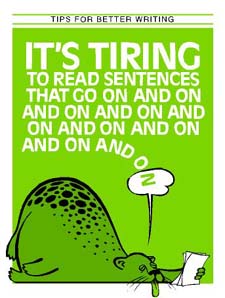
RUN-ON SENTENCES! You know the ones! Let’s talk.

When you were in school, you learned all this. Funny how we forget or never quite master these techniques. It’s okay. I’m right with you on this. We can work together to conquer the dreaded run-ons.

What is a run-on sentence?

Just as the name suggests, run-ons are sentences that have no punctuation. It would be like listening to someone thinking out loud and never taking a breath. Exhausting. And confusing. Here are a few examples:

1:  Samantha jumped on the couch she fell and hit her head.
2:  We went to the store it was closed.
3:  Trever picked up the bag it ripped groceries fell everywhere.

You can feel something wrong with those sentences, but if you’re not clear what it could be, let’s dive into the lesson. A run-on sentence is two sentences combined without proper punctuation. A period, a semicolon, or a connecting word must be added. Sounds complicated, right? It’s not, I assure you. Watch this:

1:  Samantha jumped on the couch. She fell and hit her head.
(You just made two sentences instead of one using a period. Super easy. Doesn’t it make it easier to read?)
2:  We went to the store, but it was closed.
(This is an example of a connecting word. Connecting words can be and, or, but, or then. You usually, but not always, add a comma before these words to connect the sentences.)
3:  Trever picked up the bag; it ripped and groceries fell everywhere.
(Here we used a semicolon and a connecting word such as and.)

Practice on a few sentences of your own. Pick up your old writing and analyze it a little. See if you can find places to put a period, a semicolon, or a connecting word to fix any long, endless sentences.

Want a few other options to spice up your writing? Here are three more ways to fix run-on sentences:

Comma and conjunction (connecting word):
The debate is over, and now it is time to vote.

Dash:
The debate is over – now it is time to vote.

Subordinating conjunction:
Since the debate is over, it is time to vote.

This has been,

Fanny T. Crispin